





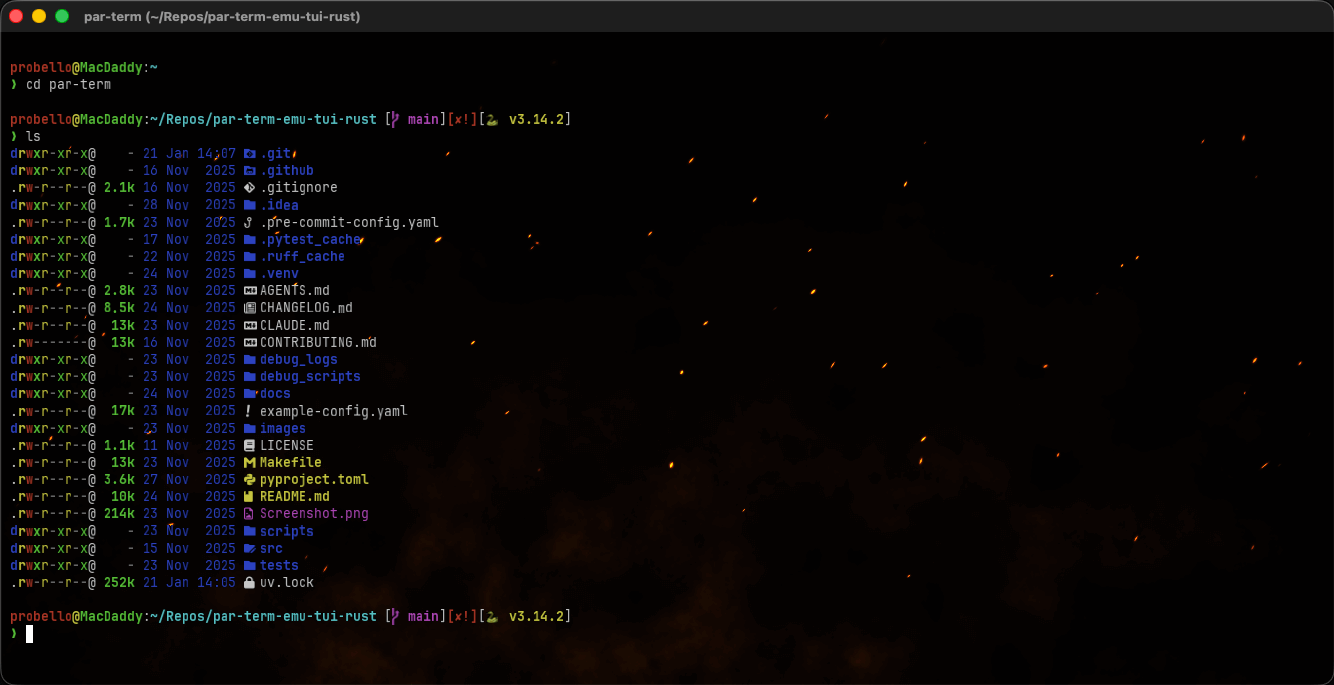
A cross-platform, GPU-accelerated terminal emulator frontend built with Rust, powered by par-term-emu-core-rust. Designed for high performance, modern typography, and rich graphics support.


- Getting Started
- What's New
- Features
- Documentation
- Installation
- Installing Shaders
- Keyboard Shortcuts
- Configuration
- Technology
- Contributing
- License
New to par-term? The Getting Started Guide walks you through installation, essential keyboard shortcuts, fonts, and split panes — everything you need to be productive in under 10 minutes.
- Getting Started Guide — Install, launch, and configure par-term
- Installation — Platform-specific install instructions below
- Configuration Reference — All 200+ configuration options
- Keyboard Shortcuts — Complete keyboard shortcut reference
- Rendering stack upgrade -- wgpu 29, egui 0.34, and
par-term-emu-core-rust0.43. Absorbs the core's breaking Rust API changes (theTerminallock is now anRwLock;Cellfields are accessors) and fixes an egui-wgpu 0.34 launch crash. - Split-pane drag-select -- drag-selecting text no longer requires holding Shift when another pane is running an alt-screen app (vim/tmux/less).
- Wrapped hyperlinks -- clicking a URL that wraps across lines opens the full URL, in both native panes and tmux.
- Kitty graphics DoS hardening -- integer-overflow in Kitty RGBA/RGB decode is now bounds-checked (from core 0.43).
- Performance -- concurrent terminal reads, a bounded LRU glyph cache, and a smaller
Cell.
For the full history of changes across all versions, see CHANGELOG.md.
- Promote Pane to Tab / Demote Tab to Pane -- new actions to move panes between tabs while preserving all running processes. Promote instantly extracts a focused pane into its own tab; demote provides a multi-step pick mode to merge a tab's pane tree into another tab.
- Kitty Terminal Graphics Protocol — Full Support -- par-term now parses, stores, renders, and responds to Kitty TGP (Phases 1–3). Virtual-placement images display correctly and autodetect probes succeed.
- Platform-Native Modifier for Hardcoded Shortcuts -- font size, clear scrollback, and clipboard history shortcuts now use Cmd on macOS instead of bare Ctrl.
- Ctrl+Punctuation Control Codes -- Ctrl with ASCII punctuation (@ [ \ ] ^ ) now correctly maps to control equivalents (e.g. Ctrl+ sends 0x1F for joe editor undo).
For the full history of changes across all versions, see CHANGELOG.md.
- Cross-platform Support: Native performance on macOS (Metal), Linux (Vulkan/X11/Wayland), and Windows (DirectX 12).
- Multi-Window & Multi-Tab: Multiple windows with independent tab sessions per window.
- GPU-Accelerated Rendering: Powered by
wgpuwith custom glyph atlas for blazing-fast text rasterization. - Inline Graphics: Full support for Sixel, iTerm2, and Kitty graphics protocols.
- Real PTY Integration: Full pseudo-terminal support for interactive shell sessions.
- Advanced Sequence Support: VT100/VT220/VT320/VT420/VT520 compatibility via
par-term-emu-core-rust. - Intelligent Reflow: Full content reflow on window resize, preserving scrollback and visible state.
- Custom GLSL Shaders: 73 included shaders with hot reload, per-shader config, terminal-aware uniforms, and cubemap support.
- Background Images: Support for PNG/JPEG backgrounds with configurable opacity and scaling modes.
- Window Transparency: True per-pixel alpha with macOS blur support and text clarity options.
- Visual Bell: Flash-based alerts for terminal bell events.
- Dynamic Themes: Support for iTerm2-style color schemes (Dracula, Monokai, Solarized, etc.).
- Standalone Settings: Dedicated settings window (F12) for live configuration editing.
- Styled Font Variants: Explicit support for separate Bold, Italic, and Bold-Italic font families.
- Unicode Range Mapping: Assign specific fonts to Unicode ranges (perfect for CJK, Emoji, or Symbols).
- Text Shaping: HarfBuzz-powered shaping for ligatures, complex scripts, and emoji sequences.
- Grapheme Clusters: Proper rendering of flag emoji, ZWJ sequences, skin tone modifiers.
- Box Drawing: Geometric rendering for pixel-perfect TUI borders and block characters.
- Smart Fallback: Automatic system font discovery and fallback chain.
- Advanced Selection: Block/Rectangular, Line-based, and Word-based selection modes.
- Multi-platform Clipboard: Seamless integration with system clipboards via
arboard. - Middle-click Paste: Standard Unix-style middle-click paste support.
- Automatic Copy: Optional "copy on select" behavior.
- OSC 8 Support: Native support for application-provided hyperlinks.
- Regex Detection: Automatic detection of URLs in terminal output.
- Interactive Links: Ctrl+Click to open links in your default browser, with hover highlighting and tooltips.
- Assistant Panel: DevTools-style side panel for terminal state inspection and ACP agent chat.
- Bundled + Custom ACP Agents: Built-in agent definitions plus custom agents via
config.yamlor~/.config/par-term/agents/*.toml. - Per-Agent Environment Variables: Configure local/provider-specific env vars (for example Ollama/OpenRouter endpoints) for each agent.
- Local Claude via Ollama: Supports
claude-agent-acpwith Ollama Claude-compatible launch mode (seedocs/ASSISTANT_PANEL.md).
- Getting Started Guide - Install, launch, and configure par-term in under 10 minutes.
- Quick Start Fonts Guide - Get up and running with custom fonts.
- Configuration Examples - Annotated YAML configuration examples.
- Environment Variables - All recognized environment variables.
- Keyboard Shortcuts - Complete keyboard shortcut reference.
- Mouse Features - Text selection, URL handling, and pane interaction.
- Semantic History - Click file paths to open in your editor.
- Automation - Regex triggers, actions, and coprocesses.
- Profiles - Profile system for saving terminal configurations.
- Session Logging - Recording sessions in Plain/HTML/Asciicast formats.
- Search - Terminal search with regex, case-sensitive, and whole-word modes.
- Paste Special - 28 clipboard transformations for pasting.
- Copy Mode - Vi-style keyboard-driven text selection and navigation.
- Snippets & Actions - Text snippets with variables, custom actions, and keybinding management.
- Progress Bars - OSC 9;4 and OSC 934 progress bar rendering and shader integration.
- Accessibility - Minimum contrast enforcement and display options.
- Integrations - Shell integration and shader installation system.
- Window Management - Window types, multi-monitor, and transparency.
- Window Arrangements - Save and restore window layouts with auto-restore.
- Command Separators - Horizontal lines between shell commands with exit-code coloring.
- SSH Host Management - SSH quick connect, host discovery, and SSH profiles.
- Status Bar - Configurable status bar with widgets and system monitoring.
- Tabs - Tab management, duplicate tab, and tab behavior.
- Assistant Panel - ACP agent chat, custom agents (UI/TOML/YAML), shader assistant, and Claude+Ollama setup/troubleshooting.
- File Transfers - OSC 1337 file transfers with shell utilities.
- Self-Update - In-place update capability via CLI and Settings UI.
- Debug Logging - Configurable log levels and troubleshooting.
- Shader Gallery - Visual gallery of 73 included shaders with screenshots.
- Shader Reference - Complete list of bundled shaders.
- Custom Shaders Guide - Create custom GLSL shaders with hot reload and per-shader config.
- Compositor Details - Deep dive into the rendering architecture.
- Architecture Overview - High-level system architecture and components.
- API Documentation Index - Public types across all workspace crates.
- Environment Variables - Runtime environment variable reference.
- Core Library - Documentation for the underlying terminal engine.
brew install --cask paulrobello/tap/par-termIf you have a Rust toolchain installed, install directly from crates.io:
cargo install par-termThis builds and installs the binary to ~/.cargo/bin/par-term.
Requires Rust 1.95+ (stable, 2024 edition) and modern graphics drivers:
# Clone the repository
git clone https://github.com/paulrobello/par-term
cd par-term

# Build with the optimized dev-release profile (~1m20s clean, ~1-2s incremental, ~90-95% of full release performance)
make build

# Run
make run

# Or build the full release binary (~3 min, for distribution)
make build-full

# Install Claude ACP bridge for Assistant Panel (Claude connector)
make install-acp
Note: The legacy package
@zed-industries/claude-code-acpwas renamed/deprecated upstream. Use@zed-industries/claude-agent-acp(claude-agent-acpbinary).
To create a native macOS .app bundle with a dock icon:
make bundle
make run-bundle
To build and install the app bundle plus the CLI binary and Claude ACP bridge in one step:
make bundle-installOn Linux, you need GTK3 and X11/Wayland libraries. Install the appropriate packages for your distribution:
Ubuntu/Debian:
sudo apt install libgtk-3-dev libxkbcommon-dev libwayland-dev libxcb-render0-dev libxcb-shape0-dev libxcb-xfixes0-dev libasound2-devFedora/RHEL:
sudo dnf install gtk3-devel libxkbcommon-devel wayland-devel libxcb-devel alsa-lib-develArch Linux:
sudo pacman -S gtk3 libxkbcommon wayland libxcb alsa-libIf macOS reports that par-term "is damaged and can't be opened", this is caused by the Gatekeeper quarantine attribute applied to unsigned binaries. Remove it with:
# For the release binary
xattr -cr target/release/par-term

# For the .app bundle
xattr -cr /Applications/par-term.app
Note: The Homebrew cask install (
brew install --cask paulrobello/tap/par-term) handles this automatically.
par-term includes 73 custom GLSL shaders for background effects and cursor animations. These need to be installed to your config directory.
Use the built-in CLI command to download and install all shaders from the latest release:
# Install shaders (with confirmation prompt)
par-term install-shaders

# Install without prompts
par-term install-shaders -y

# Force overwrite existing shaders
par-term install-shaders --forceAlternatively, use the shell script installer. The recommended approach is to download the script first, inspect it, and then run it:
# Recommended: download, inspect, then run
curl -O https://raw.githubusercontent.com/paulrobello/par-term/main/install_shaders.sh
# Review the script before executing:
less install_shaders.sh
chmod +x install_shaders.sh
./install_shaders.shNote: The one-liner pipe-to-shell pattern executes remote code without review. Use the download-then-inspect workflow above when security matters.
# Convenience only — inspect the script first when possible
curl -sL https://raw.githubusercontent.com/paulrobello/par-term/main/install_shaders.sh | sh- Download
shaders.zipfrom the latest release - Extract to your config directory:
- macOS/Linux:
~/.config/par-term/shaders/ - Windows:
%APPDATA%\par-term\shaders\
- macOS/Linux:
If building from source, copy the shaders folder manually:
# macOS/Linux
cp -r shaders ~/.config/par-term/

# Windows (PowerShell)
Copy-Item -Recurse shaders $env:APPDATA\par-term\Once installed, enable shaders in your config.yaml:
# Background shader
custom_shader: "starfield.glsl"
custom_shader_enabled: true

# Cursor shader
cursor_shader: "cursor_glow.glsl"
cursor_shader_enabled: true
See the Shader Gallery for previews of all included shaders.
Validate shader metadata, channel references, and control comments from Settings > Effects > Custom Shaders with Run Lint (and clear the current output with Clear Lint), or from the CLI with:
par-term shader-lint ~/.config/par-term/shaders/my-shader.glslAdd --readability to print a readability score plus suggested custom_shader_brightness and custom_shader_text_opacity defaults. By default, readability mode prompts before writing those suggestions into shader metadata:
par-term shader-lint my-shader.glsl --readability
par-term shader-lint my-shader.glsl --apply       # apply suggestions without prompting
par-term shader-lint my-shader.glsl --readability --no-promptEssential shortcuts to get started. On macOS, keybindings use Cmd; on Linux/Windows, they use Ctrl+Shift to avoid conflicts with terminal control codes.
| Shortcut | Action |
|---|---|
Cmd/Ctrl + T |
New tab |
Cmd/Ctrl + W |
Close tab (or window if single tab) |
Cmd/Ctrl + N |
New window |
Cmd/Ctrl + C |
Copy selection |
Cmd/Ctrl + V |
Paste from clipboard |
Cmd/Ctrl + F |
Open search |
Cmd/Ctrl + D |
Split pane horizontally |
F5 |
Reload configuration |
F11 |
Toggle fullscreen |
F12 / Cmd + , |
Open Settings |
See the full keyboard shortcuts reference for the complete list, including copy mode, pane management, shader toggles, SSH quick connect, and all customizable keybindings.
Configuration is stored in YAML format:
- Unix:
~/.config/par-term/config.yaml - Windows:
%APPDATA%\par-term\config.yaml
cols: 80
rows: 24
font_size: 13.0
font_family: "JetBrains Mono"
theme: "dark-background"
window_opacity: 0.95
scrollbar_position: "right"

# Tab bar settings
tab_bar_mode: "always"  # always (default), when_multiple, never
tab_bar_height: 28.0
tab_show_close_button: true
tab_inherit_cwd: true
dim_inactive_tabs: true
inactive_tab_opacity: 0.6

# Transparency settings
keep_text_opaque: true
transparency_affects_only_default_background: true
blur_radius: 8  # macOS only

# Power saving
pause_shaders_on_blur: true
unfocused_fps: 30

# Cursor lock options (prevent apps from overriding)
lock_cursor_visibility: false
lock_cursor_style: false
lock_cursor_blink: false

# Custom shader settings
custom_shader: "starfield.glsl"
custom_shader_enabled: true
shader_hot_reload: true  # Auto-reload on file changes

# Per-shader overrides (optional)
shader_configs:
  starfield.glsl:
    animation_speed: 0.8
    brightness: 0.3
See examples/config-complete.yaml for a full list of options.
- Terminal Engine: par-term-emu-core-rust
- Graphics:
wgpu(WebGPU for Rust) - Text:
swash+rustybuzz(custom glyph atlas) - UI:
eguifor settings and overlays - Windowing:
winit - Async:
tokio
Contributions are welcome! See CONTRIBUTING.md for the full development setup, build commands, testing workflow, commit message format, and PR process.
Before submitting a pull request:
make fmt       # Format code
make lint      # Run clippy
make test      # Run test suite
make checkall  # Run all of the above
For documentation contributions, follow the conventions in docs/DOCUMENTATION_STYLE_GUIDE.md.
This project is licensed under the MIT License - see the LICENSE file for details.
Paul Robello - probello@gmail.com
- GitHub: https://github.com/paulrobello/par-term
- Core Library: https://github.com/paulrobello/par-term-emu-core-rust