There Is No Away.
An evidence-led environmental action hub for understanding waste, reconnecting with responsibility, taking practical action, and finding trusted resources for lower-waste and more sustainable living.
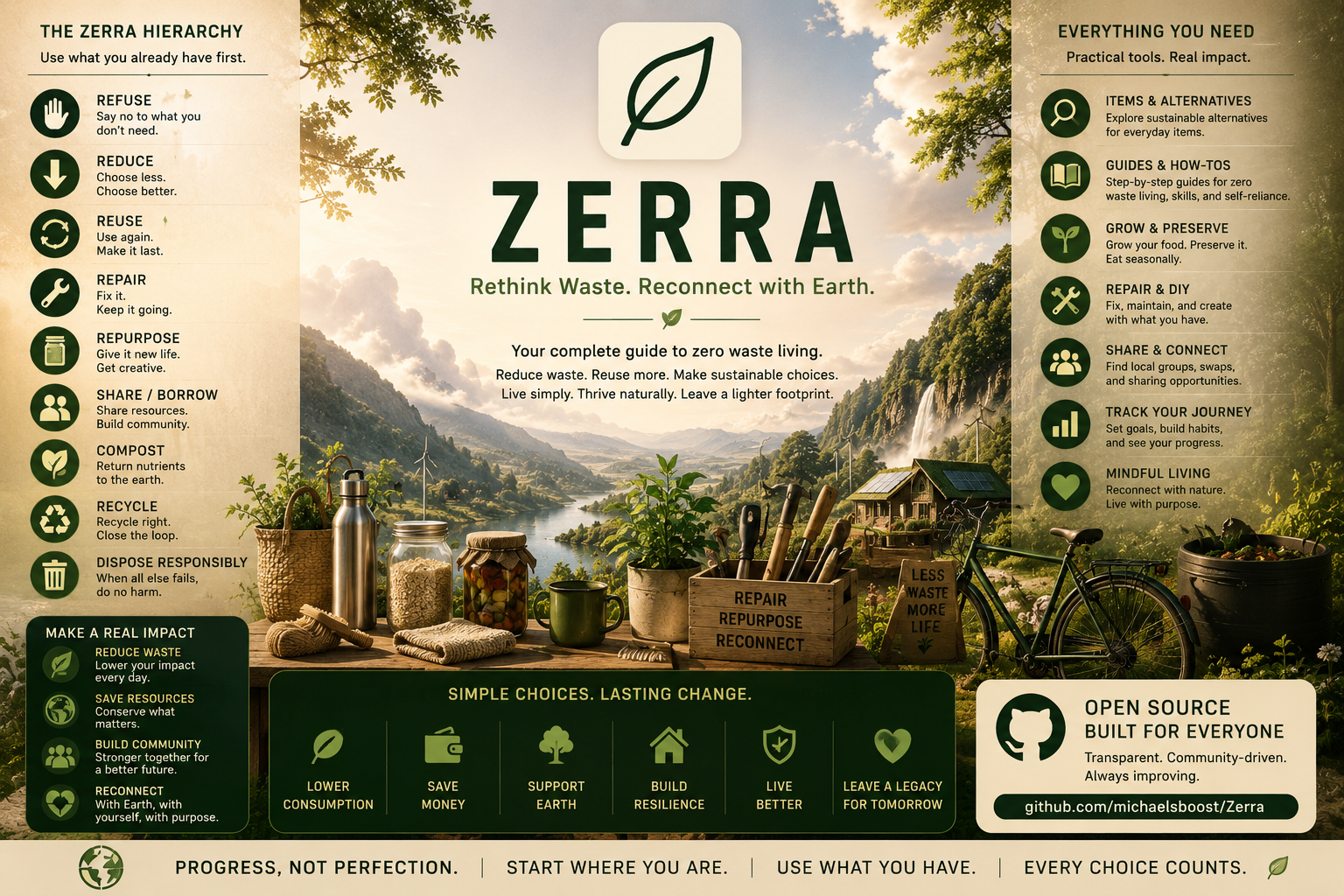


Zerra is a free, open-source environmental education and action app built around a simple reality:
You threw it away. It went somewhere.
The moment something leaves your hands is not the end of its material story. Waste moves through landfills, recycling systems, waterways, communities, ecosystems, recovery systems, and other destinations. Zerra helps make those connections visible, understandable, verifiable, and actionable.
Version 2.0 is a top-to-bottom re-engineering of Zerra. Rather than functioning primarily as a searchable catalog of items and swaps, Zerra is now organized as an educational and action hub.
Its purpose is to help people:
- see consequences that are easy to overlook
- understand how waste and material systems actually work
- verify claims through evidence and original sources
- reconnect environmental questions with stewardship, reciprocity, and responsibility
- act through practical lower-waste choices
- go deeper through trusted external resources, organizations, tools, books, films, and specialized guides
Zerra is comprehensive in direction, not exhaustive in instruction. It is designed to give someone a strong sense of where to go next without pretending that one app can contain all environmental knowledge.
Zerra 2.0 is not a routine feature update. The application has been re-engineered from top to bottom around a new information architecture, visual system, evidence standard, and user journey.
Zerra is now organized around nine focused destinations:
- Home --- consequence-first introduction, evidence, Essential Viewing, common objections, and first actions
- Why Care? --- connects waste to money, resources, communities, infrastructure, quality of life, and the future
- Learn --- explains what happens to materials and why modern waste systems work the way they do
- Reconnect --- explores stewardship, reciprocity, responsibility, ecological relationships, and carefully sourced cultural perspectives
- Act --- turns understanding into practical action through prevention, reuse, repair, sharing, recovery, composting, growing, returning, conserving, and responsible recycling
- Evidence --- provides searchable claims, context, data, reports, methodology, and original sources
- Resources --- acts as a curated gateway to documentaries, organizations, books, tools, guides, software resources, systems thinking, and deeper learning
- Stores --- helps users find secondhand, refurbished, reuse-oriented, and community resources instead of defaulting to new consumption
- About --- explains Zerra's purpose, philosophy, evidence approach, and relationship to action
The experience is designed around:
SEE IT
  ↓
UNDERSTAND IT
  ↓
VERIFY IT
  ↓
RECONNECT
  ↓
ACT
  ↓
GO DEEPER
Zerra 2.0 treats sourcing as part of the experience rather than an afterthought.
Its general evidence model is:
CLAIM
  ↓
CONTEXT
  ↓
EVIDENCE
  ↓
ORIGINAL SOURCE
  ↓
MEANING
  ↓
RESPONSIBILITY
  ↓
ACTION
Where practical, factual claims point users toward primary or authoritative sources so they can inspect the evidence themselves.
The Home page has been rebuilt around the message:
THE BIN IS NOT THE END.
You threw it away. It went somewhere.
The page combines real-world evidence, documentary photography, live waste context, Essential Viewing, common objections, and practical next steps.
Zerra includes a dedicated video-only Essential Viewing experience with films and reporting that help users understand waste, plastics, consumption, recycling, and circular systems.
The What's Your Excuse? experience addresses common objections such as:
- "But I recycle."
- "One person can't make a difference."
- "Zero waste is too expensive."
- "Companies are the real problem."
- "Zero waste is impossible."
Each response connects a quick explanation with evidence, sources, deeper context, practical action, and related viewing.
The Act and Stores experiences help users look beyond disposal and new purchases by finding useful resources near them, including categories such as:
- thrift and secondhand
- libraries
- repair
- recycling
- scrap and material recovery
- food pantries
- tool libraries
- refill shops
- makerspaces
Local availability varies, so Zerra provides discovery tools rather than assuming the same services exist everywhere.
The Resources section includes a clearly identified Systems & Futures area for exploring documented research, proposals, and critiques concerning production, consumption, circularity, resource allocation, and alternative socioeconomic frameworks.
Inclusion is not an endorsement of a political or economic model. The purpose is to give users credible starting points for investigating different approaches and their assumptions.
Zerra and Go Vegan are separate open-source projects with complementary purposes.
Zerra focuses on waste, ecological responsibility, material systems, and practical environmental action. Go Vegan focuses specifically on animal exploitation and the consequences of treating animals as products, including environmental dimensions of food and production systems.
Zerra does not present zero waste as literal perfection or a purity test.
The goal is to move decisions upstream whenever possible: prevent waste before trying to manage it after it exists.
A practical direction used throughout Zerra is:
REFUSE
REDUCE
REUSE
REPAIR
SHARE
REPURPOSE
RECOVER
COMPOST
GROW
RETURN
CONSERVE
RECYCLE CORRECTLY
For an item already in your hands, Zerra also encourages asking:
KEEP
  ↓
REPAIR
  ↓
SELL
  ↓
GIVE
  ↓
SHARE
  ↓
REPURPOSE
  ↓
RECOVER
  ↓
COMPOST
  ↓
RECYCLE
  ↓
SPECIAL HANDLING
  ↓
DISPOSE LAST
These are decision frameworks, not rigid universal rules. Materials, safety requirements, infrastructure, local regulations, accessibility, and individual circumstances can change the appropriate action.
Zerra connects environmental action with three related questions:
How do we care for what sustains us?
What do we give back in return for what we receive?
What obligations follow from our actions and their consequences?
Responsibility is not framed as household behavior alone. Individuals, communities, institutions, producers, governments, and larger systems operate at different scales and can carry different forms of responsibility.
The Reconnect section also includes carefully sourced cultural and Indigenous perspectives. Zerra avoids presenting hundreds of distinct peoples and traditions as one universal worldview; specific teachings should be understood in their own cultural and historical context.
Zerra is designed so users do not have to accept its factual claims on trust.
The Evidence section provides searchable records connecting claims to context and source material. Sources used throughout the project include public agencies, international organizations, Tribal and Indigenous sources where appropriate, research institutions, and other original or authoritative references.
Examples include:
- United Nations Environment Programme
- U.S. Environmental Protection Agency
- U.S. Department of Energy
- U.S. Department of Agriculture
- Tribal Nation and Indigenous sources where culturally specific material is discussed
Evidence and definitions can change as new data becomes available. Contributions that correct outdated claims or improve sourcing are welcome.
Zerra's Resources section is designed to help users continue beyond the app.
Resource categories can include:
- documentaries and educational films
- books
- organizations
- reports and guides
- repair resources
- composting and recycling resources
- reuse and sharing resources
- local-resource guidance
- secondhand and lower-waste shopping resources
- digital and open-source alternatives
- community resources
- systems and futures
- the Go Vegan sister project
The goal is not to duplicate every specialized resource on the internet. Zerra provides context for what a resource is, why it is useful, and where to continue learning.
Zerra does not treat buying a new "green" product as the default solution.
The Stores experience emphasizes options such as:
- secondhand
- refurbished
- reuse-oriented businesses
- repair
- refill
- borrowing and sharing
- libraries and Libraries of Things
- makerspaces
- community resources
Sometimes the best store is not a store at all.
When a purchase is genuinely necessary, Zerra helps users begin somewhere more intentional.
Moving waste out of sight does not erase its material consequences.
Refusal, reduction, reuse, repair, sharing, and recovery can prevent materials from becoming waste in the first place.
Real people have budgets, time constraints, disabilities, rental restrictions, different infrastructure, and different local options.
Environmental information should be inspectable. Zerra connects claims with context and sources wherever practical.
Individual choices matter inside larger systems. Institutional and producer decisions also shape what choices are available.
The useful question is not whether someone can become perfectly waste-free. It is what better action is realistically available in the situation they are facing.
Recycling programs, composting services, repair options, donation systems, hazardous-waste rules, and recovery infrastructure vary by location.
HOME
├── Consequence-first introduction
├── Waste context
├── Essential Viewing
├── What's Your Excuse?
└── First actions

WHY CARE?
└── Practical reasons waste matters

LEARN
└── Understand the material and waste systems

RECONNECT
└── Stewardship · Reciprocity · Responsibility

ACT
├── Prevent
├── Reuse / Repair / Share
├── Recover
├── Compost / Grow / Return / Conserve
├── Recycle correctly
└── Find resources near you

EVIDENCE
└── Claims · Context · Data · Original sources

RESOURCES
├── Films
├── Organizations
├── Guides
├── Books and deeper learning
├── Digital resources
├── Systems & Futures
└── Go Vegan

STORES
├── Secondhand
├── Refurbished
├── Lower-waste destinations
└── Community access

ABOUT
└── Purpose · Method · Philosophy
Zerra is built as a lightweight client-side web application using browser-native technologies.
- HTML5
- CSS
- JavaScript
- Alpine.js
- lightweight interface assets
Zerra is designed to be:
- responsive
- dark-theme focused
- client-side
- static-host friendly
- easy to inspect
- easy to fork
- open source
- usable without an account or application backend
The kodeWeave project export is self-contained and includes embedded application assets.
Zerra does not require an account to use the core application.
The project is intentionally client-side and does not require users to create a profile simply to access its environmental education and resources.
External resources, videos, maps, and linked services have their own privacy policies and data practices.
https://michaelsboost.com/Zerra/
Clone the repository:
git clone https://github.com/michaelsboost/Zerra.git
cd Zerra
Start a local server:
python3 -m http.server 8000Then open:
http://localhost:8000
Because Zerra is a client-side application, it can also be hosted using GitHub Pages or another static hosting provider.
Waste, recycling, composting, donation, recovery, and disposal rules vary by location.
Some materials --- including batteries, electronics, chemicals, paint, medications, sharp objects, pressurized containers, and other potentially hazardous materials --- may require special handling.
Zerra provides general educational guidance. Verify current local requirements and follow official safety instructions when handling regulated, hazardous, or location-dependent materials.
Pull requests, corrections, accessibility improvements, source updates, resource additions, and carefully researched environmental information are welcome.
Useful contribution areas include:
- correcting or strengthening factual claims
- adding primary or authoritative sources
- accessibility improvements
- responsive-layout improvements
- repair and reuse resources
- composting and recovery resources
- local-resource discovery
- responsible recycling and disposal guidance
- community resources
- secondhand and refurbished resources
- Indigenous-source corrections or improvements
- translations
- performance improvements
When contributing factual claims, distinguish evidence from interpretation and include reliable sources whenever appropriate.
Culturally specific knowledge should be attributed carefully rather than generalized across peoples or traditions.
Zerra is an independent open-source project built to make environmental consequences easier to understand, evidence easier to verify, and practical action easier to find.
If you find the project useful:
- ⭐ Star the repository
- 📢 Share Zerra
- 🧠 Contribute corrections, sources, or knowledge
- 🛠️ Submit improvements
- 💸 Support development: https://michaelsboost.com/donate
- 👕 Zerra apparel: https://michaelsboost-store.creator-spring.com/listing/zerra-unplug-from-the-system
Support helps fund continued development, research, testing, accessibility improvements, and future open-source work.
Zerra is open-source software licensed under the MIT License.
See LICENSE.
Michael Schwartz
https://michaelsboost.com