
https://github.com/ASP-NET-Web-Forms-Club/Hearth-ASPNET-Server
A lightweight, high performance, portable web server designed for ASP.NET applications. A self-contained, IIS-free host for ASP.NET Web Forms applications, built on C# 7.3 / .NET Framework 4.8. It pairs a WinForms launcher and a powerful multi-site manager supporting ASP.NET, .NET Core, Python, Node.js, and PHP side-by-side with a console / Windows-Service worker process.
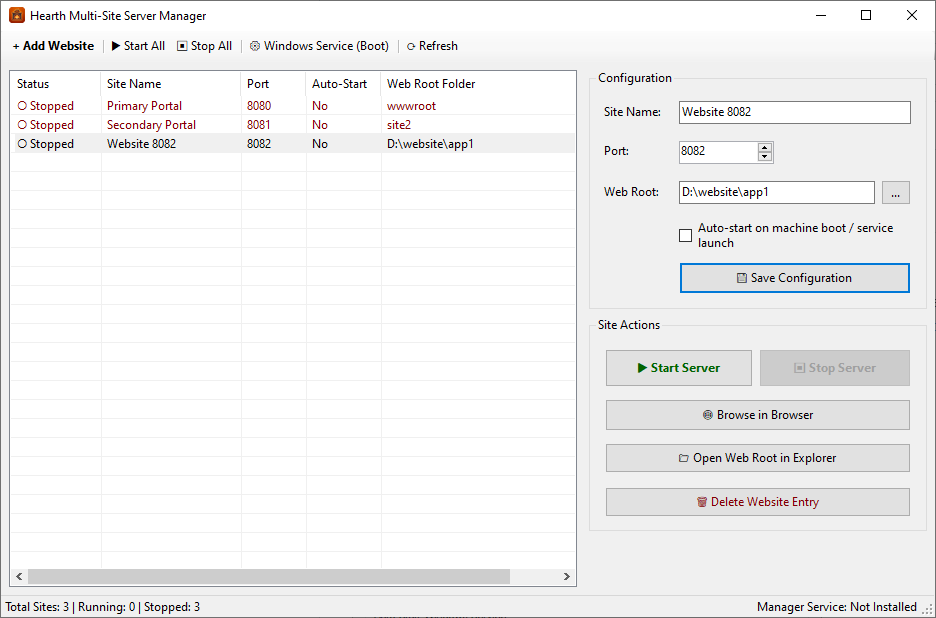
Screenshot - The Site Manager - Handling Multiple Sites
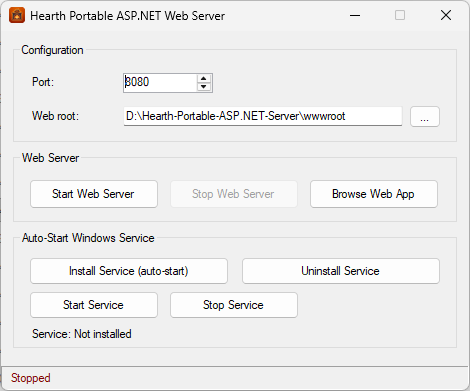
Screenshot - Single Site Launcher
While Windows (Pro/Enterprise/Server) includes IIS, IIS has distinct characteristics that make it unsuitable or cumbersome in specific scenarios:
| Dimension | Full Windows IIS | Hearth Portable ASP.NET Server |
|---|---|---|
| Portability & Footprint | System component requiring OS feature activation (dism / Windows Features). Often locked down or absent in Windows Home editions, embedded Windows, or restricted corporate machines. |
Zero install / fully portable. Run from a USB stick, a local folder, or bundled with an installer. |
| Administrative Rights | Requires Administrator privileges to configure sites, change bindings, edit applicationHost.config, and register app pools. |
Runs under standard user rights (via loopback http://localhost:<port>/ or 127.0.0.1:<port>/), requiring no admin elevation unless installing as a Windows service or binding http://+:port/. |
| Isolation & Clean Teardown | Global system-wide service; configuration drifts inside applicationHost.config; file permission issues with IIS_IUSRS. |
Complete directory and process encapsulation. Stop or delete the folder, and zero residue remains on the host machine. |
| App-in-a-Box / Self-Contained Desktop/Edge Appliance | Difficult to ship a pre-packaged desktop app that uses ASP.NET Web Forms as the UI / local server (e.g. POS systems, medical devices, internal network kiosk appliances). | Ideal for embedded web-based desktop tools. You can bundle Host.exe + Web Forms + SQLite/LocalDB and run it seamlessly like an Electron or desktop app backend. |
| Raw Pipeline Throughput | Heavier pipeline (HTTP modules, request filtering, Windows Auth modules, ETW logging, WAS). | 16% faster raw throughput than single-worker IIS in dynamic workloads (14,980 vs 12,881 req/s) because it goes straight from HttpListener into HttpRuntime.ProcessRequest with minimal middleware overhead. |
| Rapid Dev / Multi-tenant Sandboxing | Managing 10 different sites in IIS requires managing 10 app pools and site records in global IIS config. | Hearth Manager (manager_sites.json) lets you launch, stop, monitor, or watchdog multiple separate Web Forms instances dynamically by port. |
| Project | Output | Role |
|---|---|---|
HearthPortableWebServer.Common |
.dll |
Shared IPC names, server.config reader/writer, ACL'd named sync primitives. |
HearthPortableWebServer.Hosting |
.dll |
The ASP.NET runtime: HttpListener + custom HttpWorkerRequest feeding HttpRuntime.ProcessRequest. Loaded into the isolated worker AppDomain. |
HearthPortableWebServer.Host |
.exe |
Console / Windows-Service worker process. Owns the worker AppDomain lifecycle. |
HearthPortableWebServer.Launcher |
.exe |
WinForms UI: configure, start/stop, browse, install/uninstall service (single-site mode). |
HearthPortableWebServer.Manager |
.exe |
WinForms & Windows Service multi-site manager: orchestrate multiple isolated web applications, manage ports/roots, system tray, auto-start on boot, and debounced window persistence. |
HearthPortableWebServer.StressTest |
.exe |
Load generator: concurrency sweep, throughput + latency percentiles, writes a timestamped log report. |
All projects build to a shared build\<Configuration>\ folder.
 Launcher.exe (WinForms)              Host.exe (separate process)
 ────────────────────────            ─────────────────────────────
  port / root config                  default AppDomain
  Start ─► launch detached ─────────► ServerController
  Stop  ─► signal named event ──────►   │  ApplicationHost.CreateApplicationHost
  status ◄─ named mutex                 ▼
                                      ASP.NET worker AppDomain  ◄── "w3wp.exe" equivalent
                                        AspNetHost  (MarshalByRefObject)
                                        HttpListener  (32 concurrent accepts)
                                        ListenerHttpWorkerRequest ─► HttpRuntime.ProcessRequest
- Single worker process — one dedicated ASP.NET
AppDomaincreated viaApplicationHost.CreateApplicationHost, exactly how IIS isolates an app pool. - Concurrency — an async
HttpListeneraccept loop keeps 32 outstanding accepts and dispatches each request on the thread pool; Server GC is enabled. - UI independence — the Host is a separate, detached process. Closing the launcher leaves the server running; it is stopped only by an explicit signal, Ctrl+C, or the Service Control Manager.
                 HearthPortableWebServer.Manager.exe
               (WinForms Dashboard or Session 0 Service)
                                │
        ┌───────────────────────┼───────────────────────┬───────────────────────┐
        ▼                       ▼                       ▼                       ▼
  Host.exe (Port 8080)    python.exe (Port 8081)   node.exe (Port 8082)   app.exe (Port 8083)
   AppDomain: Site #1        Python: Site #2         Node: Site #3        .NET Core: Site #4
  (wwwroot / ASP.NET)       (app.py / Flask/etc.)   (server.js / Express) (Kestrel / isolated)
- Multi-Engine Orchestration — Spawns and manages dedicated, independent worker processes for ASP.NET (Web Forms / .NET 4.8), .NET Core, Python, Node.js, PHP, and custom executables side-by-side without interference or cross-talk.
- Auto Port & Env Binding — Automatically passes assigned ports via standard environment variables (
PORT,HTTP_PLATFORM_PORT,ASPNETCORE_URLS,ASPNETCORE_HTTP_PORTS) so child runtimes bind seamlessly without manual config changes. - Smart Runtime Detection — Auto-detects local virtual environments (such as
.venv\Scripts\python.exeorvenv\Scripts\python.exe), supports custom executable paths, and expands Windows environment variables (%VAR%). - Built-in Live Reload (File Watcher) — Optional live-reload file watcher monitors project files (
.py,.js,.ts,.php,.cs,.json,.config) with a 500ms debounce, automatically restarting child processes upon save. - Safe Stop Lifecycle — Stopping a running server automatically toggles its
Auto-Startsetting toNofirst, preventing unexpected background service or watchdog revivals, and terminates the full process tree (taskkill /F /T) so ports are freed with zero orphan processes. - Session 0 Pre-Login Service — Can run headless at machine boot as
HearthManagerServicebefore user login, with an active watchdog that auto-starts designated sites and auto-heals unexpected terminations. - Permission Inheritance — Automatically configures directory ACLs for
Authenticated Usersso SQLite files and uploads created by the background service (LocalSystem) remain writable by interactive users. - Debounced Layout Persistence — Modern
1200x715window fits laptop displays (1366x768) natively. Automatically monitors window adjustments and launches a 3-second countdown timer, persisting window size and coordinates towindow_layout.txt.
Run HearthPortableWebServer.Manager.exe:
- Multi-Site Dashboard: View real-time status (● Running / ○ Stopped / ⚠ Port in use) for all configured applications across distinct engines in the dedicated Type column. "Port in use" means another application (e.g. IIS) holds the site's port; Hearth never treats or stops such a process as one of its own sites.
- Multi-Engine Selection: Choose between ASP.NET, .NET Core, Python, Node.js, PHP, or Other.
- Smart Entry Defaults: Auto-suggests entry scripts (e.g.
app.py,server.js,index.php), while allowing optional custom executables or arguments. - Per-Site Controls: Dedicated Start Server, Stop Server, Browse in Browser, and Open Web Root in Explorer buttons for each application entry.
- Live Reload Checkbox: Toggle
Live Reload: Auto-restart on file changefor rapid iterative development. - Temporary Stop: Stop Server / Stop All stop sites temporarily — the watchdog service will not revive them, but their
Auto-Startsetting is kept and applies again on the next boot / service launch. Start Server / Start All lift the temporary stop. - Port Conflict Detection: Add Website picks a free port automatically; saving a site on a port already used by another application shows a warning.
- Global Controls: Start All Sites and Stop All Sites for bulk operations.
- Add & Configure Websites: Specify custom Site Name, Engine Type, dedicated HTTP Port, and relative or absolute application folder path (
manager_sites.json). Auto-migrates existingSettings.txtorserver.configon first launch. - System Tray Minimization: Closing or minimizing with running servers gives the option to minimize to the notification area with tray menu controls.
- Debounced Window Layout Saving: Automatically detects resize or reposition events and saves window location and size to
window_layout.txtafter 3 seconds of inactivity. - Windows Service Setup (Session 0 Boot): Click ⚙ Windows Service (Boot) to install
HearthManagerService. Runs headless on machine boot before user login, auto-starts designated websites, and automatically restores them if a process terminates unexpectedly.
HearthPortableWebServer.Manager.exe              (launches interactive WinForms dashboard)
HearthPortableWebServer.Manager.exe --service    (runs as background Windows Service via SCM)
A quick, one-folder / one-port tool for ASP.NET sites only. For several sites or for other engines (.NET Core, Python, Node.js, PHP), use the Multi-Site Manager.
Run HearthPortableWebServer.Launcher.exe:
- Port (default
8080) and Web root (default<startup path>\wwwroot). - Start / Stop Web Server, Browse Web App.
- Install / Uninstall Service (auto-start with Windows; prompts for UAC).
- Port conflict detection: if another application (e.g. IIS) already uses the
port, Start reports it and the status bar shows
Stopped - port N is in use by another application. - Reliable stop: Stop sends a graceful shutdown signal; if the host does not exit within 3 seconds, the Hearth host for that port is force-closed. Other applications on the port are never touched.
Closing the launcher while its server is running prompts: [Yes] stop the server and close, [No] keep the launcher open. To keep a server running after closing, install it as a Windows Service.
Launcher vs. Manager: use one or the other for a given port. They do not coordinate with each other — e.g. a Manager site with Auto-Start on port 8080 will be restarted by the Manager service even if you stop it from the Launcher.
HearthPortableWebServer.Host.exe --port 8080 --root "C:\site\wwwroot"
HearthPortableWebServer.Host.exe --stop --port 8080
HearthPortableWebServer.Host.exe --install --port 8080 --root "C:\site\wwwroot"   (admin)
HearthPortableWebServer.Host.exe --uninstall                                      (admin)
HearthPortableWebServer.Host.exe --service        (used by the SCM; reads server.config)
Run HearthPortableWebServer.StressTest.exe. With no --url it asks for the target host
interactively at runtime (accepts localhost:8080, host:port, or a full URL);
pass --url to script it. It ramps concurrency through several levels, measures
throughput and latency percentiles at each, prints the peak req/sec, and writes a
timestamped report into stress-logs\.
HearthPortableWebServer.StressTest.exe
HearthPortableWebServer.StressTest.exe --url http://localhost:8080/ --duration 10 --levels 1,2,4,8,16,32,64,128,256
The listener tries http://+:<port>/ (all interfaces, IIS-like) first and falls
back to loopback (localhost / 127.0.0.1) when not elevated. Service install
and the all-interfaces binding require Administrator rights.
Hearth hosts ASP.NET through ApplicationHost.CreateApplicationHost +
HttpRuntime.ProcessRequest (the same model as Cassini / the classic Visual
Studio dev server), not through IIS. As a result web.config is only
partially honoured:
-
Fully supported — everything the ASP.NET runtime reads itself:
<system.web>(compilation,pages,customErrors,httpRuntimeincl.maxRequestLength,authentication,authorization,sessionState,machineKey,httpModules,httpHandlers), plus<connectionStrings>and<appSettings>. Changes toweb.configorbin\recycle the site automatically. -
Partially supported —
<system.webServer>is an IIS-only section that ASP.NET itself ignores. Hearth reads the following subset from the site's rootweb.configitself:Element Supported <defaultDocument>enabled,<files>with<add>/<remove>/<clear>. Site entries are tried first, then the built-in list (Default.aspx,Index.aspx,index.html,index.htm,Default.htm) unless<clear/>is used. Sub-paths such asoffice/Default.aspxwork.<httpProtocol><customHeaders><add>/<remove>/<clear>; headers are added to every response.<staticContent><mimeMap><mimeMap>/<remove>/<clear>; overrides the Content-Type of static files.<staticContent><clientCache>cacheControlMode=UseMaxAge(withcacheControlMaxAge),DisableCache,UseExpires(withhttpExpires), pluscacheControlCustom; static files only."Static files" means existing files whose extension is not handled by ASP.NET (
.aspx,.ashx,.asmx,.axd,.svc,.cshtml, ... are excluded). Editingweb.configrecycles the site, so changes apply automatically. -
Ignored — everything else in
<system.webServer>, including<rewrite>, integrated-mode<modules>/<handlers>,<httpErrors>,<security><requestFiltering>,<httpPlatform>,<location>-scoped settings andweb.configfiles in sub-folders.
Practical notes:
- Register HTTP handlers/modules under
<system.web>(classic pipeline), not only under<system.webServer>. - Upload size is governed by
<httpRuntime maxRequestLength>(KB);requestLimits maxAllowedContentLengthhas no effect. - Use
<customErrors>(in<system.web>) for custom error pages instead of<httpErrors>. - Non-ASP.NET engines (PHP, Python, Node.js, .NET Core) do not read
web.configat all. For PHP pretty URLs (e.g. WordPress permalinks), use a router script instead of URL Rewrite rules.
msbuild HearthPortableWebServer.sln /p:Configuration=Release
- ASP.NET Web Forms page renders with ViewState; server-side button postback
updates a
Label(full page lifecycle). - ASP.NET AJAX
[WebMethod](page methods) and.asmxweb services supported (decomposesPathInfosub-paths like/Page.aspx/MyMethod). api.aspxechoes GET query and POST form values.- Static files served with
ETag/Last-Modifiedcaching headers. - 200 concurrent requests → 200 × HTTP 200 in ~0.12 s.
--stopsignal shuts the worker down gracefully and frees the port.- Manager orchestrates multiple concurrent sites across distinct engines (ASP.NET, .NET Core, Python, Node.js, PHP) and distinct ports (
8080,8081, etc.) with individual start/stop lifecycle management. - Live reload automatically detects file updates and restarts child processes without manual intervention.
- Stopping a site safely sets
Auto-StarttoNofirst, preventing watchdog restart loops, and terminates all child process trees cleanly. - Manager automatically debounces and restores window layout coordinates (
window_layout.txt) via a 3-second timer.
Read more details report at: Wiki - Performance Benchmark
The same ASP.NET Web Forms application was load-tested twice on the same
machine — once hosted by this portable server, once by the Windows 11 built-in
IIS (single worker process) — using HearthPortableWebServer.StressTest. Each run
ramped concurrency from 1 → 256 clients, 10 s measured per level (3 s warmup), with
every response body fully read.
Test machine (both client and server ran here, over loopback):
| Component | Spec |
|---|---|
| CPU | Intel Core i7-4770S @ 3.10 GHz (Turbo 3.90 GHz), 4 cores / 8 logical |
| Cache | L1 256 KB · L2 1.0 MB · L3 8.0 MB |
| RAM | 24 GB DDR3 |
| Storage | Samsung SSD 870 EVO 500 GB |
| OS | Windows 11 |
| Concurrent clients | Portable server | IIS (1 worker) |
|---|---|---|
| 1 | 3,346 | 2,825 |
| 2 | 6,088 | 4,698 |
| 4 | 9,847 | 7,777 |
| 8 | 13,460 | 10,783 |
| 16 | 14,494 | 12,349 |
| 32 | 14,700 | 12,456 |
| 64 | 13,849 | 12,683 |
| 128 (peak) | 14,980 | 12,881 |
| 256 | 12,696 | 12,208 |
| Summary | Portable server | IIS (1 worker) |
|---|---|---|
| Peak throughput | ≈ 14,980 req/s (≈ 899K req/min) | ≈ 12,881 req/s (≈ 773K req/min) |
| Peak at concurrency | 128 | 128 |
| Failures | 0 | 0 |
| Total requests served | 1,034,924 | 887,020 |
On this dynamic workload the portable server was ~16 % faster at peak and faster at every concurrency level, with lower latency — because it runs a far leaner request pipeline (no native-module chain, no access logging, no process-management overhead), while sharing the same underlying HTTP.sys kernel driver as IIS.
The full per-level latency breakdown (p50/p90/p95/p99/max) is published on the project wiki. This README keeps the summary only.
Both servers show identical behavior under load: throughput saturates around concurrency 8–16, peaks at 128, eases off at 256, and neither drops a single request. The latency growth past saturation is textbook Little's Law. In short — it behaves like a real server under load.
While the portable server intentionally does not match IIS's full feature set (kernel output caching, web gardens, request filtering, TLS/auth modules, logging, health monitoring, app-pool recycling…), it fully delivers on its core mission: an efficient web server that yields the output — here, matching and slightly exceeding stock single-worker IIS in raw throughput.
Caveats. Client and server shared the same 8 logical CPUs over loopback, so both ceilings are understated; a second-machine test over the network would raise both. The ~16 % gap reflects stock/default configuration of each (e.g. IIS logging enabled) and a non-cacheable dynamic page — a cacheable response would let IIS's kernel cache pull far ahead.