Pure-browser video downloader — it parses M3U8/HLS playlists (and direct
.mp4/.ts/… links), decrypts AES-128 segments, transmuxes to MP4, and streams
the result straight to disk, all client-side, with no upload and no server.
Preview: https://vidl.pages.dev/
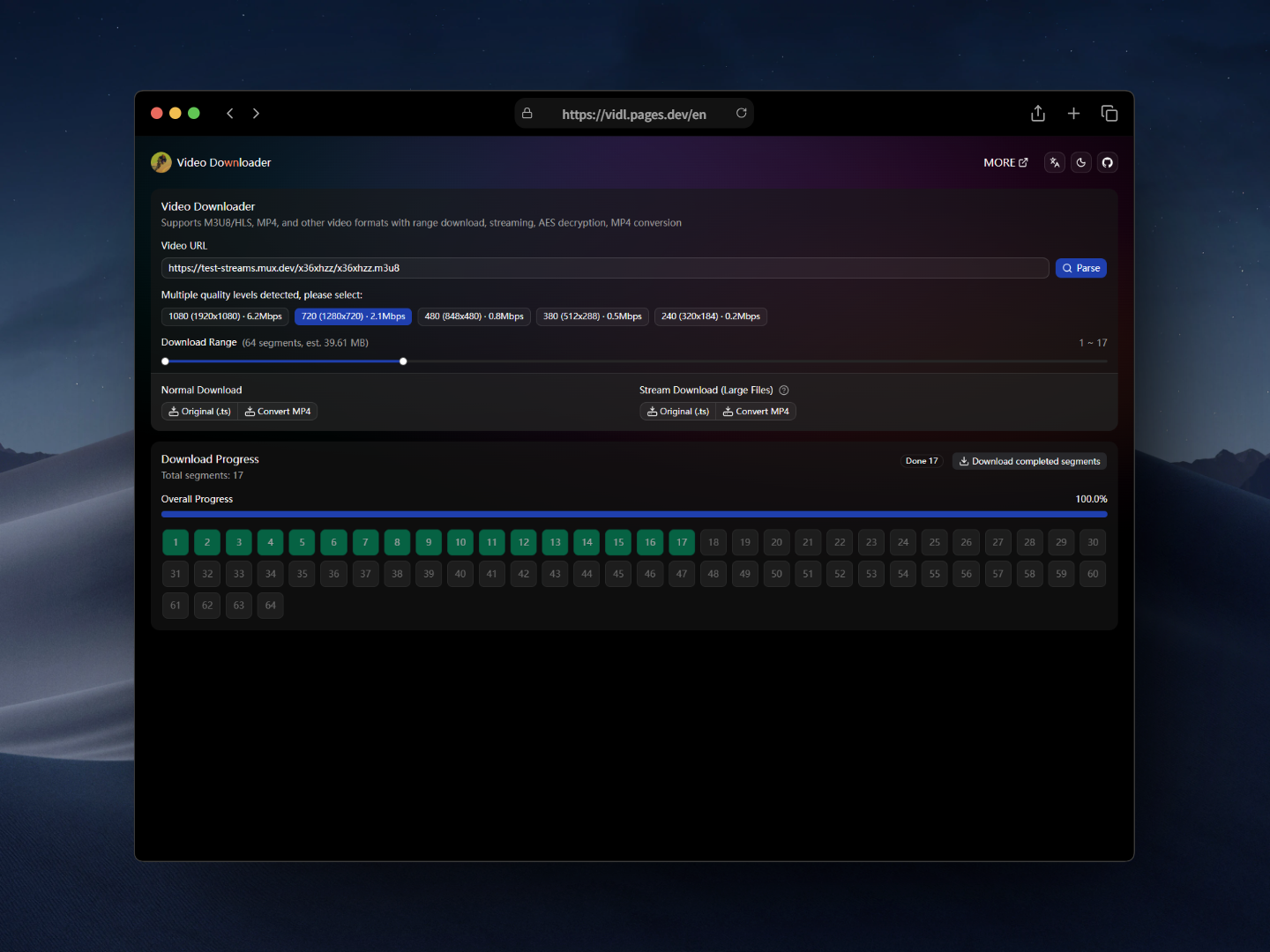
The whole pipeline — fetch, AES-128-CBC decrypt, TS→MP4 transmux, and the write
to disk — runs in the page. A DownloadEngine class drives a concurrent
segment worker pool and, in stream mode, pipes each finished segment through
StreamSaver.js into a WritableStream so a multi-GB video never has to sit in
memory.
Every "online M3U8 downloader" is a server that fetches the video for you: it
sees the URL, proxies the bytes, and often rate-limits or injects ads. The
browser-native alternatives make you install an extension. vidl is neither —
it's a static site (output: 'export') that does the work locally:
- Nothing is uploaded. The URL you paste, the encryption key, and the video bytes stay in your tab. There is no API layer, no backend, no logging.
- Encrypted HLS just works.
#EXT-X-KEYis auto-detected; the key is fetched and each segment is AES-128-CBC decrypted in a hand-rolled decryptor before muxing — no plugins. - Big files don't OOM the tab. Stream mode writes segments to disk as they
arrive (Streams API via
StreamSaver.js), so peak memory is one segment, not the whole file. Safari falls back to in-memory automatically. - Batch + range. Queue many URLs, or grab a slice of segments — each with its own quality / format / filename.
- Resilient. Per-segment retry with exponential backoff, a background watchdog that re-queues stalled segments, pause/resume, and manual retry.
- Not a proxy. Every fetch is a browser request to the third-party host, so downloads only work for CORS-permissive origins. There is no server to bypass CORS — this is the one real-world limitation.
- Not a player. Use the one-click jump to byplay to preview a stream.
- No DRM. It decrypts standard HLS AES-128; it does not touch Widevine / FairPlay / clearkey-EME content.
- Mixed content. The app is served over HTTPS, so
applyURLupgrades segment URLshttp:→https:; http-only segment hosts may fail.
vidl is part of the @cdlab/projects-monorepo; run
everything from the repo root.
pnpm install                       # builds workspace packages too
pnpm --filter @cdlab/vidl dev      # -> http://vidl.localhost:3355
The dev URL is fixed by @dotns/nsl — no port
hunting. Paste an M3U8 or direct-video URL, press Enter to parse, pick a
variant / format / range, and download. A default Mux test stream is pre-filled
so you can try it immediately.
You can also deep-link a URL to auto-parse on load:
http://vidl.localhost:3355/en?url=<m3u8-url> (url or source query param).
paste URL → parse → configure → download
  1. isDirectVideoUrl?  → HEAD for size, done (direct download path)
  2. must contain "m3u8"; fetchData() gets the manifest text
  3. isMasterPlaylist?  → parse variants (BANDWIDTH/RESOLUTION/NAME),
                          sort by bandwidth desc, auto-select highest, re-fetch
  4. parseMediaPlaylist → segment URLs (applyURL: relative→absolute, http→https),
                          default range [1..N], sampled file-size estimate (HEAD × 3)
  5. startDownload(isGetMP4): clamp range, sum #EXTINF durations for the muxer
  6. #EXT-X-KEY?        → fetch key, expandKey → AESDecryptor
  7. downloadTS         → shared-cursor worker pool (concurrency segments in flight),
                          per-attempt retry with exponential backoff
  8. per segment dealTS → AES-CBC decrypt → conversionMp4 (dynamic import mux.js)
  9. checkCompletion    → in-memory: assemble Blob & download
                          stream:    write sequential segments to disk, close writer
flowchart TD
    A["paste URL"] --> B{"isDirectVideoUrl?"}
    B -->|yes| D["directDownload: fetch → Blob → save"]
    B -->|no| C["fetchData(manifest)"]
    C --> M{"isMasterPlaylist?"}
    M -->|yes| V["pick highest-bandwidth variant → re-fetch"]
    M -->|no| P["parseMediaPlaylist → segment list"]
    V --> P
    P --> S["startDownload → worker pool (downloadTS)"]
    S --> K{"#EXT-X-KEY?"}
    K -->|yes| DEC["AES-128-CBC decrypt each segment"]
    K -->|no| MUX
    DEC --> MUX{"MP4?"}
    MUX -->|yes| TX["mux.js transmux TS → MP4"]
    MUX -->|no| W
    TX --> W{"stream mode?"}
    W -->|yes| STR["write segment → disk (StreamSaver)"]
    W -->|no| MEM["buffer in memory → Blob on completion"]
The full model — the two retry mechanisms, the stream vs. in-memory paths, the
AES IV fallback, and the CORS constraint — is in DESIGN.md.
Runtime download tuning lives in useSettingsStore, persisted to
localStorage under vidl-download-settings, and edited from the settings
dialog. The engine reads these through an injected getSettings().
| Setting | Key | Default | Meaning |
|---|---|---|---|
| Concurrency | concurrency |
6 |
Segments fetched in parallel (worker-pool size, capped at pending count). |
| Timeout | timeoutMs |
30000 |
Per-segment fetch timeout (AbortController). |
| Max retries | maxRetries |
3 |
Attempts per segment before it is marked error. |
| Retry base delay | retryBaseDelayMs |
1000 |
Backoff base; attempt n waits base · 2ⁿ. |
There is no .env, no binding, and no secret — the app is a static export.
The only build-time value is BUILD_TIME (next.config.ts), surfaced in the
version footer.
| Kind | Handling |
|---|---|
| M3U8 / HLS (media) | Parsed into segment URLs; downloaded as .ts or transmuxed to .mp4. |
| M3U8 / HLS (master) | Variants parsed (BANDWIDTH / RESOLUTION / NAME), sorted desc, highest auto-selected. |
| AES-128 HLS | #EXT-X-KEY auto-detected; key fetched, each segment AES-128-CBC decrypted. |
| Direct video | mp4, webm, mkv, avi, mov, flv, wmv, mpg, mpeg, ts (VIDEO_MIME_MAP) — fetched whole and saved. |
| Path | Responsibility |
|---|---|
src/lib/download-engine.ts |
DownloadEngine — parse / download / pause / resume / retry / cancel / reset / destroy; the shared-cursor worker pool; in-memory + stream completion paths; MP4 transmux; a 2s retryAll watchdog. |
src/lib/m3u8-parser.ts |
Master-vs-media detection + #EXT-X-STREAM-INF variant parsing. |
src/lib/aes-decryptor.ts |
AESDecryptor — standalone AES-128-CBC (S-box, key expansion, block decrypt, PKCS7 unpad). |
src/lib/video-utils.ts |
Shared types + constants, VIDEO_MIME_MAP, fetchData (timeout + external abort signal), applyURL, estimateFileSize, triggerBrowserDownload. |
src/lib/batch-utils.ts |
fetchUrlMetadata — resolves a URL to {isDirectVideo, variants, segmentCount, estimatedSize, resolvedUrl} for the batch queue. |
src/stores/ |
Zustand: download-store (single), batch-store (queue), settings-store (persisted tuning). |
src/hooks/ |
use-download-actions (single engine + auto-parse from ?url=) and use-batch-actions (a second, silent engine for the queue). |
src/components/downloader/ |
SourceCard, ProgressCard, SettingsDialog, BatchInputCard, BatchQueueCard, BatchItemRow. |
public/static/ |
Vendored StreamSaver.js, mitm.html, serviceWorker.js for stream-to-disk writes. |
src/
  app/
    page.tsx                  root → redirect('/en') (static export)
    [locale]/layout.tsx       HTML shell: fonts, next-intl, providers, JSON-LD SEO
    [locale]/page.tsx         the app: single/batch tabs, loads StreamSaver.js
  lib/                        download engine + parsers + AES + utils (framework-agnostic)
  stores/                     Zustand: download / batch / settings
  hooks/                      engine wiring (single + batch)
  components/downloader/      the UI cards
  components/layout/          theme, language, providers
  i18n/                       next-intl routing / request / navigation
  middleware.ts              next-intl locale middleware
messages/{en,zh}.json         UI strings
public/static/                StreamSaver.js + mitm.html + serviceWorker.js
DESIGN.md                     architecture + engine / stream / AES spec
llms.txt                      agent-oriented usage guide
pnpm --filter @cdlab/vidl build       # next build → static export (output: 'export')
pnpm --filter @cdlab/vidl build:cf    # @cloudflare/next-on-pages (Pages build wrapper)
pnpm --filter @cdlab/vidl typecheck   # tsc --noEmit
pnpm --filter @cdlab/vidl lint        # next lint
vidl is a static site — next.config.ts sets output: 'export', so there
is no server, edge function, or Cloudflare binding. It deploys to Cloudflare
Pages as static assets (https://vidl.pages.dev/); build:cf is only the
Pages build wrapper. There are no tests in this app.
DESIGN.md is the authoritative spec — the engine's state model,
the worker pool and the two independent retry mechanisms, the stream vs.
in-memory paths, the AES decryption + IV fallback, the batch subsystem, and the
CORS / mixed-content constraints. Read it before changing download orchestration,
completion detection, or the stream writer.