Free, browser-based text-to-speech — 290+ neural voices, adjustable rate / pitch, long-text auto-splitting, and a pluggable "API manager" so you can bring your own TTS backend. A single Next.js app; no account, no Azure key, no server database.
Preview: https://bytts.pages.dev/
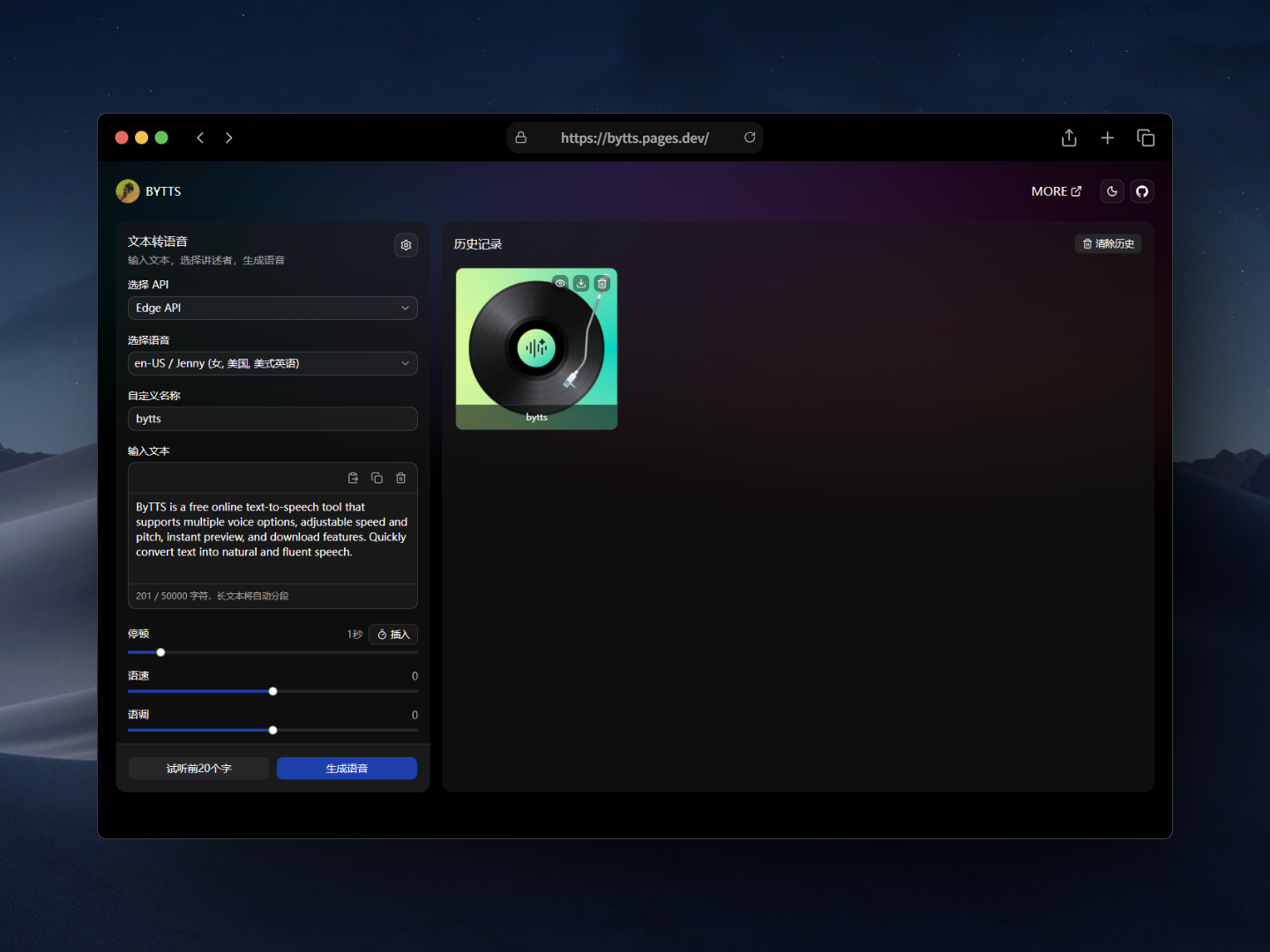
The built-in synthesizer proxies the free "Microsoft Edge Read Aloud" speech
pipeline: an Edge route derives a short-lived token with a reverse-engineered
HMAC signature, wraps your text in SSML, and streams the clip back as
audio/mpeg. Everything else — history, custom providers, playback — lives in
the browser (IndexedDB + localStorage); there is no backend store to run.
Good TTS is either locked behind a paid cloud SDK or trapped in a native app.
bytts gives you the neural voices with none of that:
- No key, no bill — the built-in
edge-apiprovider reaches Microsoft's free Edge speech endpoint via a signed request; you never register an Azure subscription. - Long text just works — a width-aware splitter chops text up to 50,000 characters on sentence / clause boundaries, synthesizes each segment, and merges the audio back into one clip — no manual chunking.
- Bring your own backend — the API manager lets you point at any OpenAI-format or Edge-format TTS endpoint, override a built-in's URL / key / limits, and switch providers from one picker.
- Your data stays local — the whole generation history, audio included, lives in your browser's IndexedDB. Nothing is uploaded; there is no database and no telemetry.
- One artifact — a Next.js app deployed to Cloudflare Pages. The only server-side code is two Edge routes.
bytts is part of the @cdlab/projects-monorepo; run
everything from the repo root.
pnpm install            # builds workspace packages too
pnpm dev:bytts          # -> http://bytts.localhost:3355
The dev URL is fixed by @dotns/nsl — no port
hunting. Type text, pick a voice, hit Generate; use the 20-character preview
to audition a voice before committing to a full render. No environment variables
are required — set ACCESS_PASSWORD only if you want a gate (see below).
Generate voice (built-in Edge API)
  1. splitText(text, splitLength)          width-aware split on punctuation
  2. genid.nextId() → requestId            Snowflake-style id; addHistory(PROCESSING)
  3. per segment → POST /api/tts           {text, voice, rate, pitch, preview}
  4. server: refreshEndpoint()             cached MS token (HMAC-signed), per isolate
  5. server: generateSsml() + escapeXml    SSML built server-side; text XML-escaped
  6. server: POST cognitiveservices/v1     → arrayBuffer as audio/mpeg
  7. client merges segment blobs → 1 Blob  updateHistory(COMPLETED, audioBlob)
  8. history row (metadata + blob) → IndexedDB
flowchart TD
    A["TTSForm: text + voice + rate/pitch"] --> B{"preview?"}
    B -->|"yes (first 20 chars)"| P["POST /api/tts · play · no history"]
    B -->|no| S["splitText → segments"]
    S --> R["POST /api/tts per segment"]
    R --> T["refreshEndpoint: cached MS token (HMAC sig)"]
    T --> U["generateSsml + escapeXml → cognitiveservices/v1"]
    U --> M["merge segment blobs → one audio/mpeg Blob"]
    M --> H["history row (metadata + blob) → IndexedDB"]
The preview path (generateVoice(true)) only synthesizes text.slice(0,20),
plays it via an object URL, and writes no history — it is a throwaway
audition.
Two providers ship built in; you can add your own or override the built-ins in place (edits are non-destructive and restorable to defaults).
| Provider | Format | Endpoint | Max length | Split |
|---|---|---|---|---|
Edge API (edge-api) |
edge |
/api/tts (this app) |
50,000 | 5,000 |
OAI-TTS (oai-tts) |
openai |
https://oai-tts.zwei.de.eu.org/v1/audio/speech (9 voices) |
4,096 | 4,096 |
| Custom | edge or openai |
your endpoint | per-config | per-config |
- A custom provider is stored in localStorage (
bytts-custom-apis) with its own endpoint, key, auth-header name, voice list, and segmentation toggle. It sits alongside the built-ins in the picker. - A built-in override (
{endpoint?, apiKey?, authHeaderName?, maxLength?, splitLength?}) is merged over the default —{...BUILTIN_APIS[id], ...override}— and can be reset. - Auth header semantics: each provider names its own auth header (default
Authorization) and value. When fetching a model list, a key sent underAuthorizationis auto-prefixed withBearer; on the actual TTS request the key is sent verbatim under the configured header. Other header names are always sent as-is. - Format quirks: OpenAI requests strip
<break>tags and sendresponse_formatfrom the UI. Theoai-ttsbuilt-in sendsmodel: 'tts-1', voice: <speaker>; a custom OpenAI provider mapsmodel: <speaker>, voice: 'alloy'(the selected voice becomes the model).
Both routes run on the Edge Runtime (export const runtime = 'edge').
Synthesizes one clip. Request body (JSON):
| Field | Type | Default | Meaning |
|---|---|---|---|
text |
string | — | Text to convert (required). |
voice |
string | zh-CN-XiaoxiaoMultilingualNeural |
Voice short name; validated against /^[a-zA-Z0-9\-_]+$/. |
rate |
number | 0 |
Speech rate, -100…100 (percent). |
pitch |
number | 0 |
Pitch, -100…100 (percent). |
format |
string | audio-24khz-48kbitrate-mono-mp3 |
X-Microsoft-OutputFormat value. |
preview |
boolean | true |
false adds a Content-Disposition: attachment download header. |
Response: audio/mpeg bytes (the raw synthesized clip). Errors return
{ error } with 400 (bad params) or 500.
GET → { hasEnvPassword, persistPassword } (seeds the client gate).
POST { password } → { valid } — a plain string compare against
ACCESS_PASSWORD.
All optional; bytts runs with none set. Read from process.env in the Edge
routes / layout.
| Variable | Default | Meaning |
|---|---|---|
ACCESS_PASSWORD |
(empty) | Site password. Empty disables the gate. Read in api/config + layout.tsx. |
PERSIST_PASSWORD |
true |
false forces password re-entry every session (no localStorage unlock). |
MICROSOFT_CLIENTTRACEID |
(empty) | Optional X-ClientTraceId seed for the MS endpoint fetch. |
BUILD_TIME |
(injected) | Set at build in next.config.ts; surfaced in the version footer. |
No server database — all persistence is client-side.
| Store | Backend | Key | Holds |
|---|---|---|---|
useApiStore |
localStorage | bytts-custom-apis |
Custom providers + built-in overrides. |
useHistoryStore |
IndexedDB (bytts/stores) |
bytts-results |
Full history — metadata and audio Blob (PROCESSING items dropped). |
History is persisted with @cdlab/zustand-idb:
IndexedDB stores values through the structured clone algorithm, so the audio
Blob survives a reload as-is — no metadata/blob split, no rehydration
bookkeeping. Hydration happens on the client only (skipHydration +
persist.rehydrate()).
- The password gate is client-side only.
PasswordGategates rendering, not the API.POST /api/ttshas no auth — anyone hitting the endpoint directly bypassesACCESS_PASSWORD. Do not treat it as access control for the synthesis backend; it only hides the UI. - The built-in voice relies on a reverse-engineered endpoint.
edge-apisigns requests to Microsoft's free Edge speech pipeline with a hardcoded HMAC key and spoofed client headers — not official Azure Cognitive Services with a subscription key. It can break if Microsoft changes the scheme, and is a ToS grey area. For guaranteed availability, add your own provider via the API manager. - In-flight generations are not persisted. A
PROCESSINGitem lost to a refresh simply disappears (by design) rather than hanging. - Not a voice cloning / custom-voice tool; it only drives the voices the chosen backend already exposes.
pnpm --filter @cdlab/bytts typecheck    # tsc --noEmit
pnpm --filter @cdlab/bytts lint         # next lint
pnpm --filter @cdlab/bytts build        # next build --webpack (forced webpack builder)
There is no test script — the project has no tests. The build script
forces the webpack builder (--webpack); Turbopack is not used here. Deploy
target is Cloudflare Pages via @cloudflare/next-on-pages (there is no
wrangler.jsonc — it is a Pages Functions build, not a raw Worker);
next.config.ts also emits output: 'standalone' for a Node self-host fallback.
DESIGN.md is the source-of-truth spec — the synthesis proxy and
its token/signature scheme, SSML assembly and injection defense, the segmentation
algorithm, the provider model, and the client storage design. Read it before
changing the request pipeline, the SSML escaping, or the history persistence
split.