The ecosystem exposes the same MEOS temporal and spatiotemporal operations on three stream processors — MobilityFlink, MobilityKafka, and MobilityNebula. This page reports, measured rather than estimated, how much of the streamable MEOS surface each one covers, how that coverage is verified, and how the platforms perform on the BerlinMOD benchmark. Together these answer the question a prospective adopter asks first — is the streaming layer complete, does it return correct results, and is it fast enough to deploy on real workloads? — with reproducible evidence rather than assertion.
Companion: Databases — parity & benchmarks reports the same for the SQL engines (MobilityDB / MobilityDuck / MobilitySpark).
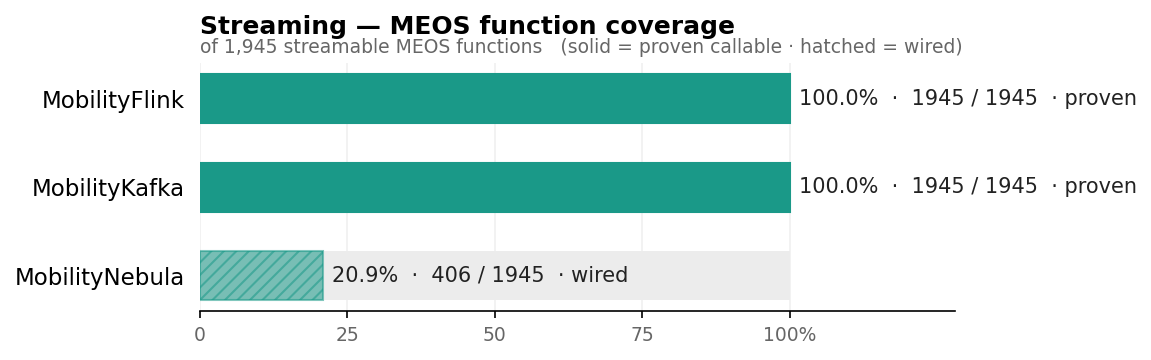
Coverage of the 1,945 streamable MEOS functions — confirmed callable on a real libmeos:
- Correctness — all 9 BerlinMOD queries × 3 streaming forms = 27/27 cells reproduce the batch result on every platform; the Flink snapshot output is byte-identical to the batch oracle.
▶ Full results & raw data
- Per-function coverage — committed feeds
flink-kafka.feed.tsv+nebula.feed.tsv, reproduced byci_gate.py(MobilityNebulatools/streaming_parity/). - Methodology —
doc/methodology/streaming_parity_assessment.md(MobilityNebula).
The reference is the 1,945 streamable MEOS public functions — every exported MEOS
function that can run inside a streaming dataflow, across four tiers: stateless,
bounded-state, windowed, and cross-stream.
Functions outside that surface are excluded by reason, not by omission, and are never counted as gaps:
| reason | count | why it is not streamable |
|---|---|---|
| internal | 1,308 | not part of the public API |
| io-meta | 218 | parsing / output / catalog plumbing (*_in, *_out, …) |
| ambiguous | 59 | reserved pending a semantic decision |
| sequence-only | 14 | need a fully materialized sequence; no per-event form |
Three layers, increasing in strength:
- L1 — exported. The symbol is present in
libmeos(nm -D). - L2 — wired. A binding operator or facade method calls it.
- L3 — proven. It is actually invoked on a real
libmeos: confirmed callable (JVM tools) or exercised by a passing systest (NebulaStream).
| Platform | L3 proven | L2 wired | of 1,945 |
|---|---|---|---|
| MobilityFlink | 1,945 callable | 1,945 | 100.0 % |
| MobilityKafka | 1,945 callable | 1,945 | 100.0 % |
| MobilityNebula | 61 systest-confirmed | 406 wired · compile-verified | 20.9 % wired |
Flink and Kafka share one generated JNR-FFI facade, so their callability is identical;
it is confirmed by a type-aware per-method harness that invokes every facade method
on a real libmeos (a returned value or a caught MEOS semantic error counts as
callable — only a linkage or marshalling failure does not). NebulaStream operators are
generated C++ physical operators; each is compile-verified against the build's
libmeos in the NebulaStream development image, and a systest suite confirms
callability operator by operator.
The three platforms run the 9 BerlinMOD reference queries in three streaming forms — continuous, windowed, and snapshot — 27 of 27 cells per platform, with the snapshot form anchored to the batch (SQL-engine) result at the same scale factor. Every cell reproduces the batch result, and the Flink snapshot output is byte-identical to the batch oracle. This links streaming parity to database parity.
Coverage and correctness establish that the queries run and agree; the BerlinMOD benchmark establishes that they run fast enough to deploy. The same reference queries are timed on each platform across scale factors and the three streaming forms (continuous / windowed / snapshot), reporting per-query throughput and latency. Because the workload definition is shared with the SQL engines (MobilityDB-BerlinMOD), streaming and batch timings are directly comparable at the same scale factor.
The timing methodology is the one defined for the SQL engines in MobilityDB-BerlinMOD #29 (measurements reported by what each is licensed to claim); the workload and harness are in place, and the timing tables join this page as they are measured. SQL-engine timings appear in the companion databases — parity & benchmarks page.
The numbers come from committed feeds and need no toolchain:
# MobilityNebula: tools/streaming_parity/
python3 ci_gate.py          # Flink/Kafka: 1945/1945 = 100.0%, no over-claim
cat feeds/nebula.feed.tsv   # NebulaStream: wired / proven, per function
The feeds (flink-kafka.feed.tsv, nebula.feed.tsv) are regenerated by the
per-platform adapters and the callability harness in tools/streaming_parity/; the full
methodology is in doc/methodology/streaming_parity_assessment.md (MobilityNebula).
Measured against the accumulate/parity-1.4 MEOS build, 2026-05-23. Flink and Kafka are
complete at 100%; the NebulaStream figure is the operator surface wired and compile-verified.